Sermons Blog
-
My first memory of thinking about the theme of neurodiversity, and autism in particular.
Was as a teen, watching the movie Rain Man,
which came out in 1988,
Starring Tom Cruise and Dustin Hoffman.(Nils Skudra review)
Now as a disclaimer: this movie contains dated, inaccurate portrayals of autistic people and we have come a long way in understanding autism spectrum disorder, both medically and socially since then.
In the movie, Dustin Hoffman plays an autistic man, a mathematical genius with photographic memory. In a dinner scene he is able to count the exact number of toothpicks that have fallen to the floor: and he uses this skill to count poker cards in a casino and win large sums of money.
The movie has its flaws! but I remember while watching it at the time, having an epiphany,
a realization that people who appear different on the surface can have gifts,
That their different ways of thinking can be fascinating, and potentially beyond what society calls normal.
The movie expanded my thinking about autism as more than just a disability, but also that there are possible strengths.
It prompted me to start thinking of people with neurological issues as not just disabled, disordered or broken, but perhaps that they were able to see and interact with the world
in a different way,
Contribute to society, and be whole and human in a distinct manner.
Since 1993, I’ve obviously matured, and I’ve done some learning on the topic of autism in the past few years and particularly this past week, and especially working with and hearing from Corey and her excellent first-hand point of view presentation.
The phrase that sticks out for me (in a prior draft) is the “beauty vs. the pain of Neurodivergence.”
-
For this morning’s Bible readings, except for the Gospel, we chose alternate texts that fit today’s theme,
With the overarching idea that Neurodiversity is part of the diversity of Creation.
Just as there is a diversity of plants, animals,
planets and stars, so the diversity of humans includes
left-handed, right-handed people,
Blue eyes and brown eyes,
neurodivergent and neurotypical.
We are fearfully and wonderfully made.
God created humans in God’s image,
and so that includes all the neurological variety among humans as well.
-
Isaiah 43:
In our first reading from Isaiah we hear a love letter from God.
God formed us, neurodivergent and neurotypical.
God called us by name: “you are mine!
When you pass through the waters, the times of chaos or times of trial, I will be with you!
I am the Lord YOUR God
You are precious in my sight, and I love you!”
Neurodivergent and neurotypical people experience their world and God differently and also in similar ways.
All humans have a longing for God, for connection to the divine, and God is there by our side, loving us and caring for us when the going gets tough.
1 Corinthians
The reading from 1st Corinthians utilizes a metaphor, a comparison:
(v12)
As the human body is one, but has many members, many parts, so it is with Christ, and Christ’s body, Christ’s family.
Though there are many members with different gifts, we are all one in Christ.
(v13)
Through our baptism, we are all baptized into one body. Baptism forms us, despite our differences, into a unity.
Baptism is the common denominator, the common thread that binds us.
Jewish Christians and Gentile Christians,
Slaves and free
Male, female
Neurodivergent and neurotypical.
“If a foot says “because I’m not a hand, I do not belong to the body—this does not make it any less —a part of the body.”
So it is with the Christian family:
if the neurodivergent person says: because I’m not neurotypical I don’t belong to the human family: this does not make this person any less part of the body. All members are needed and necessary.
The eye cannot say to the hand: I have no need of you.
The neurotypical cannot say to the neurodivergent: I have no need of you.
The weaker members are indispensable.
Christian love for all who are weaker, less quote “honourable”,
Are clothed with greater honour,
God gives greater merit to the inferior member.
Those who face more challenges conforming to society’s expectations, negotiating life in this chaotic and difficult environment, those God honours more.
And we all have a responsibility: that the members have the same care for one another, no matter their neurological condition,
Because if one member suffers, all suffer with it!
Is one member is honoured, all rejoice with it!
All are connected as members of Christ’s body.
—
Now the concept of Neurodiversity is complex, controversial, and within the Neurodiversity community, the medical community and within affected groups there is much diversity of opinion on many of these topics.
But I think there’s value in remembering that there are people who believe neurodiversity is not something that needs to be cured,
And that Neurological diversity isn't only characterized by disorders or diseases, but is also identified as “differences”.
I think our task is to appreciate, and learn more about neurodiversity,
To listen to neurodivergent voices and their experiences of lived reality,
With humility, to try to understand their point of view.
And to see where we can change and improve things.
We need patience and empathy, and this goes both ways,
As there are barriers to understanding between Neurotypical and Neurodivergent, which makes it sometimes challenging.
There is still much to do!We will make mistakes, and hopefully we can improve along the way.
—-
One area as a congregation we can get more informed about
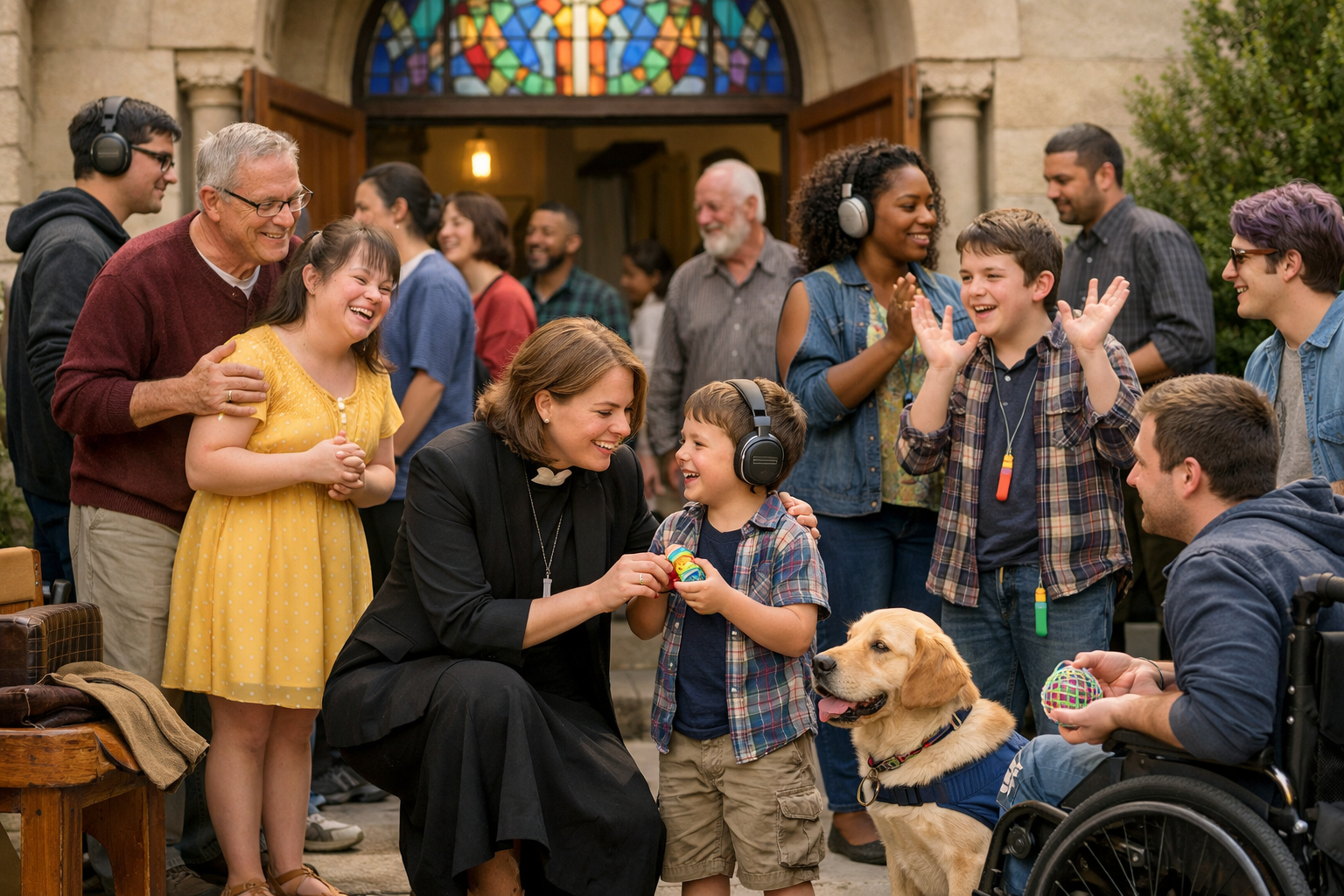
is the issue of coping mechanisms. For example, some autistic people and people with ADHD will use “Stimming” which is short for
self-stimulatory behavior. It refers to repetitive actions people may do to help regulate feelings, focus, or cope with stress, excitement, or sensory input.
Examples include:
hand flapping
rocking
tapping fingers
repeating words or sounds
pacing or
humming
But many people stim in some way. I sometimes do some of these behaviours. It is not automatically a problem; it can be a natural way of self-soothing or concentrating.
How tolerant as a congregation could we be to stimming during worship?
Our first reaction might be to give the person a “stare”: to stop it,
But maybe if we understand more why they need to do it, we can be more compassionate.
We all process information in different ways.
There are a few congregants who have told me:that they can concentrate better to my sermons if they close their eyes.
Some people have difficulty sitting on a bench for a full hour-and a quarter service,
some people need to fidget with something to concentrate, or they find that knitting helps them stay focused.
Some people have sound and light sensitivities.
I think we need to give people space, tell them:
“Your self-regulation is OK” even though it may be a little strange to us, or distracting.
Let’s figure it out together. (Anne Anderson)
Another way we’ve started to integrate neurodiversity into our programming is in our Children’s Day Camps.
We have an assigned quiet room (like the Parlour) where neurodivergent kids who get overstimulated can go, get some quiet and take time to de-compress.
We all probably can understand the need to unwind and get away from a group when we feel overwhelmed. And so this small step of a quiet room accommodates the needs of a variety of children.
Human diversity is both amazing and challenging!
We live in a diverse community; naming certain themes like Black History, Indigenous Peoples’ Sunday, and Neurodiversity, we acknowledge members of our congregations’ lived experience, and that they, that you are welcome.
One of our new congregational priorities is to “Create an inclusive culture of hospitality and welcome.”
And so for all of you with a neurodiversity:
It’s great that you’re here!
God loves you!
We love you.
-
Our Hymn of the Day is a popular German Christian song from 1981,
Translated as “You are My hiding Place.”
It applies to both Neurodivergent and Neurotypical people who long for security esp. when afraid, or out of sorts.
Knowing that God is a place we can flee to,
Is a good reason to turn to God.
When we have a secure place,
we feel safe and can fill our bucket, and recharge,
And then we can go and do amazing things
because we are strong again.

Leave a Comment